


Production ready as of v0.5.0 — the fgbio-parity release.
fgumi's output is validated against
fgbio across a wide range of
vendor-provided data, and we now recommend fgumi over fgbio for UMI
processing. The two intentionally differ in a handful of places — most visibly
MI tag values, and dedup --no-umi, which drops fgbio's strand-of-origin
split to match Picard MarkDuplicates. The divergences we know of are
catalogued in the
migration guide.
As with any change to a production pipeline, validate against your own data before switching, and please open an issue for any divergence that isn't documented.
Fulcrum Genomics Unique Molecular Indexing (UMI) Tools - a suite of high-performance tools for working with UMI-tagged sequencing data.

Visit us at Fulcrum Genomics to learn more about how we can power your Bioinformatics with fgumi and beyond.


fgumi provides comprehensive functionality for:
- UMI extraction from FASTQ files
- Read grouping by UMI with multiple assignment strategies
- UMI-aware deduplication for marking/removing PCR duplicates
- Consensus calling (simplex, duplex, and CODEC)
- Quality filtering of consensus reads
- Read clipping for overlapping pairs
- Metrics collection for QC and analysis
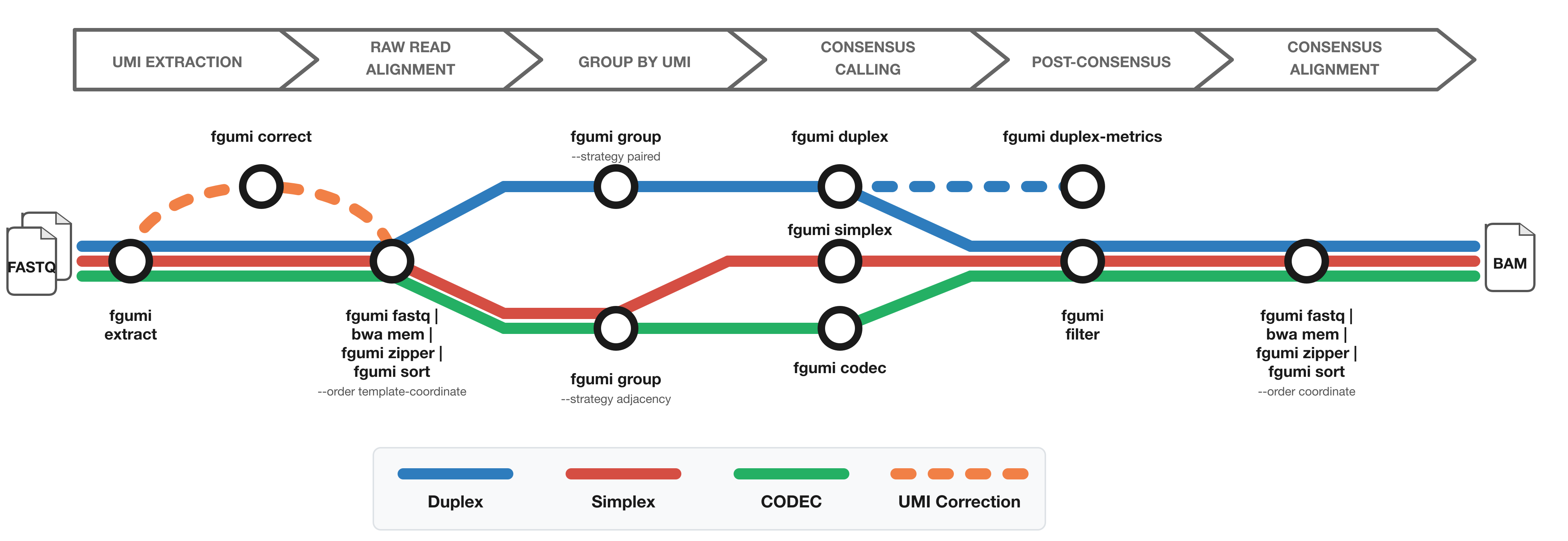
The diagram shows the workflow from FASTQ files to filtered consensus reads:
- Red: Simplex (single-strand) consensus
- Blue: Duplex (double-strand) consensus
- Green: CODEC consensus
- Orange: Optional UMI correction for fixed UMI sets
- Documentation
- Best Practice Pipeline: Recommended workflow from FASTQ to consensus
- Migration from fgbio: Tool mapping, key differences, and known divergences
- Performance Tuning Guide: Threading, memory, and compression optimization
- Snakemake Pipeline: Reference implementation
- Metrics: Output metrics documentation
- Developing: Developer guide
- Compare CLI: Compare command documentation (feature-gated)
- Simulate CLI: Simulate command documentation (feature-gated)
- Releases
- Issues: Report a bug or request a feature
- Pull requests: Submit a patch or new feature
- Discussions: Ask a question
- Contributors guide
- License: Released under the MIT license
Pre-built binaries for the most common operating systems and CPU architectures are attached to each release for this project.
cargo install fgumi
Clone the repository:
git clone https://github.com/fulcrumgenomics/fgumi
Build the release version:
cd fgumi
cargo build --release
| Feature | Description |
|---|---|
compare |
Developer tools for comparing BAMs and metrics |
simulate |
Commands for generating synthetic test data |
profile-adjacency |
Enable profiling output for adjacency UMI assigner |
Enable with: cargo build --release --features <feature> |
| Command | Description | Equivalent Tool(s) |
|---|---|---|
extract |
Extract UMIs from FASTQ files | fgbio ExtractUmisFromBam |
correct |
Correct UMIs based on sequence similarity | fgbio CorrectUmis |
zipper |
Merge alignments back onto the unmapped BAM, restoring its tags | fgbio ZipperBams, picard MergeBamAlignment |
fastq |
Convert BAM to FASTQ format | samtools fastq |
sort |
Sort BAM by coordinate/queryname/template | — |
group |
Group reads by UMI | fgbio GroupReadsByUmi |
dedup |
Mark/remove UMI-aware duplicates | gatk UmiAwareMarkDuplicatesWithMateCigar, umi-tools dedup |
simplex |
Call single-strand consensus reads | fgbio CallMolecularConsensusReads |
duplex |
Call duplex consensus reads | fgbio CallDuplexConsensusReads |
codec |
Call CODEC consensus | fgbio CallCodecConsensusReads |
filter |
Filter consensus reads | fgbio FilterConsensusReads |
clip |
Clip overlapping read pairs | fgbio ClipBam |
duplex-metrics |
Collect duplex metrics | fgbio CollectDuplexSeqMetrics |
review |
Review consensus variants | fgbio ReviewConsensusVariants |
downsample |
Downsample BAM by UMI family | N/A |
compare <cmd> |
Compare files (feature-gated) | N/A |
simulate <cmd> |
Generate test data (feature-gated) | N/A |
For detailed usage of each command, run:
fgumi <command> --help- Extract UMIs from FASTQ:
fgumi extract \
  --inputs R1.fastq.gz R2.fastq.gz \
  --read-structures +T +M \
  --output unaligned.bam \
  --sample MySample \
--library MyLibrary- (Optional) Correct UMIs for fixed UMI sets:
fgumi correct \
  --input unaligned.bam \
  --output corrected.bam \
  --umi-files umis.txt \
--min-distance 1- Align and sort reads using fgumi fastq + zipper + sort pipeline:
fgumi fastq --input unaligned.bam \
  | bwa mem -p ref.fa - \
  | fgumi zipper --unmapped unaligned.bam \
| fgumi sort --output sorted.bam --order template-coordinate- Group reads by UMI:
fgumi group \
  --input sorted.bam \
  --output grouped.bam \
  --strategy paired   # for duplex workflows
# or --strategy adjacency for simplex/codec workflows- Call consensus reads:
# Simplex consensus
fgumi simplex \
  --input grouped.bam \
  --output consensus.bam

# Or duplex consensus
fgumi duplex \
  --input grouped.bam \
  --output duplex.bam

# Or codec consensus
fgumi codec \
  --input grouped.bam \
--output codec_consensus.bam- (Optional) Collect duplex metrics:
fgumi duplex-metrics \
  --input grouped.bam \
--output metrics- Filter consensus reads:
fgumi filter \
  --input consensus.bam \
  --output filtered.bam \
  --ref ref.fa \
--min-reads 1,1,1fgumi supports multi-threading and memory management for optimal performance:
- Threading:
--threads Nfor parallel processing - Memory:
--max-memory 768(plain numbers are MiB; supports human-readable formats like2GB; passautoto size to the host) - Compression:
--compression-level 1-12for speed vs size trade-offs
Memory Model — Important for fgbio users: Unlike fgbio's JVM
-Xmxwhich sets a hard ceiling on total process memory, fgumi's--max-memorycontrols pipeline queue backpressure only. Two things to be aware of:
- Per-thread scaling (default):
--max-memory 768 --threads 8allocates 768 MiB per thread = ~6 GB total queue memory. Use--memory-per-thread falsefor a fixed total budget, or--max-memory autoto size the budget to the host (cgroup-aware, minus--memory-reserve) so the command self-throttles instead of OOM-ing.- Queue memory < total process memory: Actual RSS will be higher due to UMI data structures, decompressors, thread stacks, and working buffers.
See the Performance Tuning Guide for detailed guidance, including scenario-based configurations and troubleshooting.
fgumi is written in Rust for maximum performance.
| Command | Key Optimizations |
|---|---|
extract |
Work-stealing thread pool, streaming I/O |
correct |
N-gram indexing with pigeonhole principle, BK-tree for k>1 |
group |
2-bit UMI encoding, N-gram/BK-tree indexing, directed adjacency graph |
simplex |
Fast-path for unanimous consensus, parallel processing |
duplex |
Parallel duplex calling, efficient strand matching |
codec |
Parallel CODEC consensus |
filter |
Streaming filter with parallel processing |
clip |
Parallel overlap detection and clipping |
sort |
External merge sort, configurable memory limit |
- 2-bit DNA encoding: 4 bases in 1 byte, 32 bases in u64
- CPU intrinsics: XOR + popcount for Hamming distance
- Work-stealing scheduler: Unified pipeline with dynamic load balancing
- libdeflate: Fast BGZF compression
fgumi's UMI grouping algorithms are inspired by:
- UMI-tools (Smith et al. 2017) - The directed adjacency method for UMI deduplication with count gradient constraints.
- UMICollapse (Liu 2019) - N-gram and BK-tree indexing strategies for efficient similarity search in UMI deduplication.
Development of fgumi is supported by Fulcrum Genomics.
This software is under active development. While we make a best effort to test this software and to fix issues as they are reported, this software is provided as-is without any warranty (see the license for details). Please submit an issue, and better yet a pull request as well, if you discover a bug or identify a missing feature. Please contact Fulcrum Genomics if you are considering using this software or are interested in sponsoring its development.